
Game Monetization Report
Commercial models, pricing psychology, and live revenue mechanics for games businesses
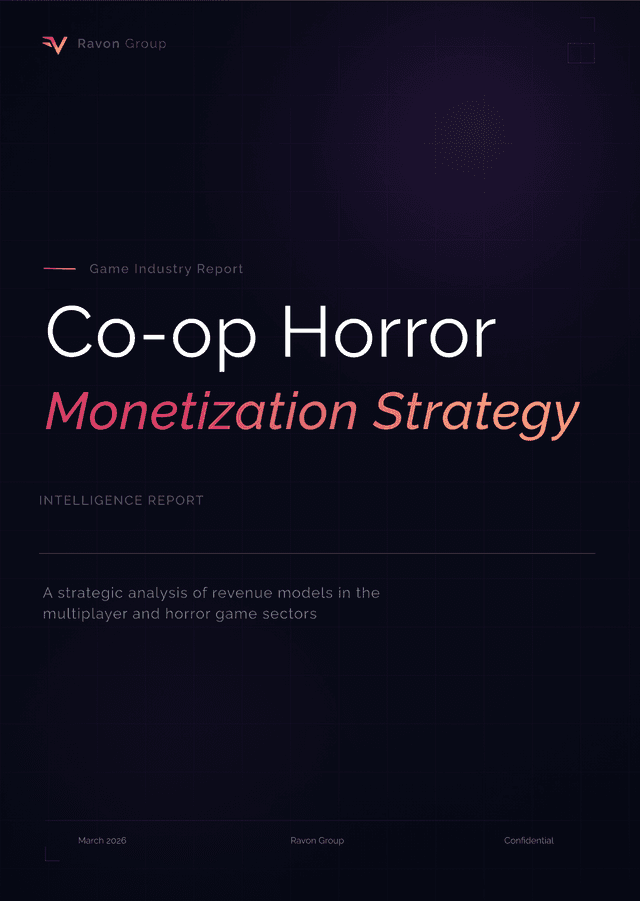
A practitioner-oriented view of monetisation architecture: how successful games align offers, progression, and fairness signals.
What's inside
Key highlights
A glimpse of what the full piece covers — not the underlying data or full narrative.
- 01
When premium, battle pass, cosmetics, and gacha-adjacent models fit — and when they misfire
- 02
How progression pacing interacts with conversion and churn
- 03
Regional and platform constraints that change rollout strategy
- 04
Telemetry and experimentation guardrails responsible teams adopt
- 05
Checklist for leadership reviews before scaling monetisation changes
Executive summary
Direct answers
- 01
Co-op horror monetization works best when it preserves fairness and social cohesion.
- 02
Retention-led sequencing beats early monetization pressure in this category.
- 03
Studios should instrument economy changes with community-sentiment controls.
This guide translates co-op horror market dynamics into monetization decisions for live teams.
It focuses on model selection, rollout sequencing, and trust-preserving revenue design.
Related services
Choose Model by Social Loop Fit
Monetization fit lens
| Model | Strength | Primary risk |
|---|---|---|
| Premium base price | High trust and simple conversion | Limited long-tail ARPU if cadence is weak |
| Cosmetic live items | Low gameplay integrity risk | Requires strong content identity pipeline |
| Seasonal bundles | Recurring revenue cadence | Perceived fatigue if value framing is weak |
| Utility monetization | Short-term yield potential | Community backlash if fairness is affected |
Prioritize models that do not distort cooperative tension design.
Rollout Sequencing
- Validate retention and recurrence before heavy monetization expansion.
- Use sentiment and churn telemetry as hard gates for pricing experiments.
- Communicate economy changes with transparent rationale and rollback paths.
Frequently asked
What monetization mistake is most common in co-op horror?
Pushing short-term revenue mechanics before social loop retention is stable.
Methodology & citations
Guide derived from report economic analysis and live-ops operating patterns in co-op multiplayer contexts.
Sources
Source 01: Co-op Horror Gaming: Industry Research Report, March 2026.
Internal proof references
Proof 01: Revenue-outcome patterns tied to retention-first sequencing in social multiplayer launches.
Prepared by Ravon Group Research Team — Strategic Intelligence
Game economy strategy and live-operations design practice.
Related services
How this topic connects to how we engage with clients.