
The Global Nonwoven Technical Textiles Industry Report 2026
Market Structure, Competitive Dynamics, and Strategic Opportunities for Industrial Manufacturers
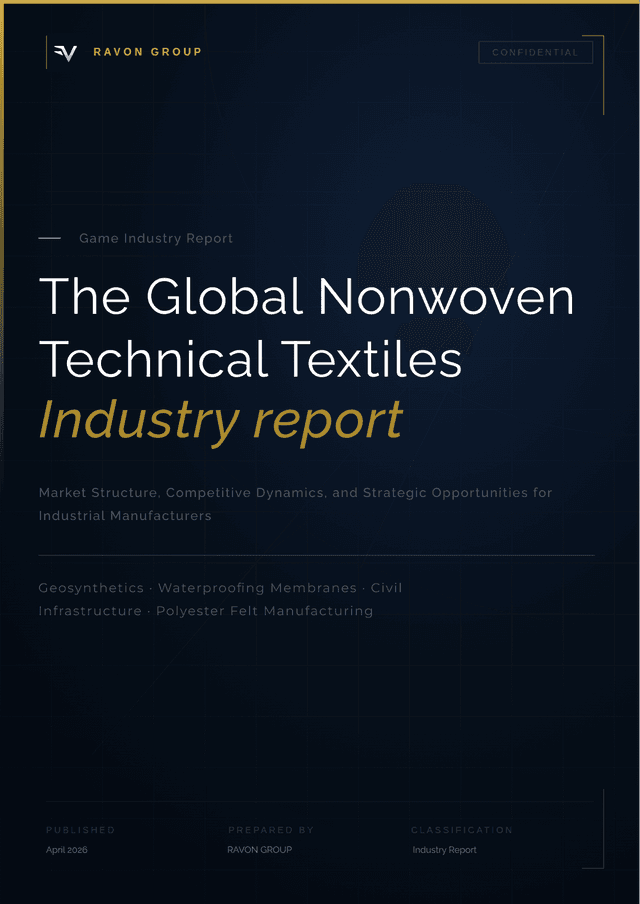
Strategic intelligence for industrial manufacturers in nonwovens and adjacent technical textiles: segments, competition, and growth vectors.
What's inside
Key highlights
A glimpse of what the full piece covers — not the underlying data or full narrative.
- 01
Segment-level demand drivers across geosynthetics, membranes, and civil infrastructure applications
- 02
Competitive dynamics: scale players, specialists, and regional champions
- 03
Capacity, input cost, and sustainability pressures reshaping margins
- 04
M&A and partnership patterns as buyers seek vertical integration
- 05
Where digital and AI-enabled operations are starting to differentiate manufacturers
Executive summary
Direct answers
- 01
What changed: nonwoven technical textiles moved from commodity competition toward certification-driven, specification-led market access.
- 02
Who should act now: nonwoven felt manufacturers, membrane buyers, distributors, and export-focused industrial groups planning 2026-2028 investments.
- 03
Top opportunities: CE and EcoVadis readiness, mid-premium Turkish export positioning, and productivity gains from reinforced felt and AI-assisted quality control.
The global nonwoven technical textiles market is expanding alongside infrastructure demand, but value capture is shifting to suppliers that combine quality consistency with documented credentials.
EU sustainability and compliance requirements are converting certifications from optional differentiators into procurement gatekeepers. This restructures competition across Europe, MENA, and adjacent export corridors.
For Turkish manufacturers, geographic and cost advantages remain strong. The main execution gap is no longer production capability; it is certification depth, digital specification infrastructure, and channel presence.
Related services
Market Structure at an Inflection Point
Demand growth in geosynthetics and bituminous membrane value chains is increasing, yet procurement standards are rising faster than many regional suppliers can match.
As a result, competitive dynamics are bifurcating between credentialled specialists and price-led commodity manufacturers with shrinking access to high-spec projects.
Core market snapshot (2024 to 2030)
| Segment | 2024 size | 2030 projection | CAGR | Planning implication |
|---|---|---|---|---|
| Global geosynthetics | $10.8B | $18.7B | 8.2% | Infrastructure pipeline remains primary growth engine |
| Nonwoven geotextiles | $4.1B | $7.1B | 8.5% | Largest product subset with rising spec requirements |
| Bituminous membranes | $15.4B | $24.6B | 7.9% | Carrier felt quality and stability become procurement priorities |
| Carrier felt (PET nonwoven) | $0.82B | $1.4B | 8.3% | Differentiated felt captures premium beyond commodity pricing |
Based on report synthesis referencing Grand View Research, Smithers Apex, EDANA, and industry estimates.
Certification and Sustainability as Access Infrastructure
- CE marking increasingly determines eligibility for specification-led and public infrastructure projects in EU-linked markets.
- EcoVadis and comparable sustainability ratings are moving into baseline supplier qualification workflows.
- CSRD and related disclosure pressures are cascading procurement requirements down to SME suppliers through buyer questionnaires and audits.
KEY INSIGHT
Credential gaps now create revenue exclusion risk, not just reputation risk.
Manufacturers that close CE and sustainability readiness early gain structural pricing and access advantages.
Value Chain Power and Margin Capture
- 01
Where margin concentrates
Bituminous membrane producers typically capture higher absolute margin due to downstream brand and contract control.
Felt manufacturers can improve economics by shifting mix toward reinforced and higher-spec formulations.
- 02
Differentiation lever
Glass fibre-reinforced felt demonstrates a practical premium segment with measurable productivity impact.
The commercial case is operational ROI, not only input price comparison.
- 03
Channel strategy
Distributor partnerships remain efficient for market-entry speed in fragmented geographies.
Direct channels become viable only at sufficient recurring volume concentration.
Regional Demand Map and Export Advantage
MENA and Central Asia show the highest growth rates and strongest import dependency dynamics in near-term planning windows.
Turkey sits in a favorable logistics position across EU, MENA, and CIS-linked demand corridors, supporting a mid-premium export strategy.
Growth-focused regional lens
| Region | Current share | Growth profile | Strategic relevance |
|---|---|---|---|
| Europe | 31% | 4.5% CAGR | High standards; credential quality is mandatory |
| Asia-Pacific | 29% | 9.8% CAGR | Large demand but intense price competition |
| MENA | 9% | 11.2% CAGR | High project pipeline and import opportunity |
| Central Asia and CIS | 5% | 13.1% CAGR | Fastest growth with proximity advantage for Turkey |
Use with channel capability and compliance readiness scoring for expansion sequencing.
Operational Maturity Upgrade Path
- Priority 1: establish CE readiness for at least one lead product line to unlock specification-led demand.
- Priority 2: complete sustainability credential baseline and improve score trajectory with documented actions.
- Priority 3: strengthen digital technical infrastructure (datasheets, DoP, certificates, multilingual content).
- Priority 4: convert trade-fair presence into distributor and frame-contract pipeline with measurable conversion targets.
Frequently asked
Why are CE and sustainability credentials now critical in this category?
Because buyers increasingly use them as procurement filters for risk, compliance, and specification assurance.
Where is the main pricing pressure today?
Commodity felt segments face sustained pressure while differentiated, performance-validated products retain better pricing power.
What is the strongest near-term export opportunity for Turkish suppliers?
Mid-premium positioning across MENA, Central Asia, and selected EU-linked demand where certified quality and lead-time matter.
Do trade fairs still matter in this market?
Yes. In-person technical qualification and distributor development remain high-leverage for conversion in industrial procurement.
What is the first 90-day strategic move?
Run a credential-and-access audit: CE status, sustainability readiness, digital specification assets, and channel coverage by target region.
How should buyers evaluate reinforced felt alternatives?
Use total operational impact (line speed, rejects, stability, waste) rather than ex-works material price alone.
Methodology & citations
Report synthesis combines market sizing references, value-chain mapping, competitive tier analysis, regulatory signal review, and implementation-grade case evidence from industrial manufacturing contexts.
Sources
Source 01: The Global Nonwoven Technical Textiles Industry Report 2026, Ravon Group, March 2026.
Source 02: Grand View Research, Smithers Apex, and EDANA market references used in report sizing and forecast framing.
Source 03: EU regulatory and procurement context referenced in report sections on CE marking, CSRD, and sustainability-led qualification.
Internal proof references
Proof reference 01: Glass fibre-reinforced carrier felt case: line-speed and rejection-rate improvements under production trial conditions.
Proof reference 02: Trade fair conversion case: qualified lead generation and distributor-contract outcomes from INDEX participation.
Prepared by Ravon Group Research Team — Strategic Intelligence
Industrial market strategy, manufacturing operations intelligence, and certification-linked growth planning.
Related services
How this topic connects to how we engage with clients.